

Find Joy and Quiet Through Listening to Immanuel with Others
Somewhere in the swirl of a full day, with roles to juggle and people to tend, most of us quietly learn to stop noticing. A gentle numbness settles in. We forget our own hearts. We answer “I’m fine” before we have even asked ourselves how we really are. The hustle carries us, and the heart grows quieter.
The practice of checking in is how we come home to ourselves. It is a small, sacred pause, a moment to notice what is stirring and to let it matter. And it is the foundation of one of the most transformative rhythms we cultivate at JoyPath as we grow in our Immanuel lifestyle together.
When we take time to notice what’s alive within us, using simple tools like SASHET (Sad, Angry, Scared, Happy, Excited, Tender), we move beyond surface-level interactions into the rich territory of true connection. This practice doesn’t just help us identify our emotions; it opens a doorway to understanding our deeper needs, and invites us to bring our whole selves, not just our “put-together” selves, into relationship with others and with God.
Emotions Are Messengers, Not Problems
Before we can listen to our hearts, it helps to make peace with what we find there. Our emotions are not interruptions to be managed, or evidence that something is wrong with us. They are messengers.
Like the blinking oil light on a dashboard, an emotion is telling us something true about what is happening beneath the surface. Dismiss it, and we are quietly propelled by forces we cannot see. Acknowledge it, and we honor ourselves, unlocking the keys to contentment and to our truest selves. This is why checking in is never self-indulgent. It is simply how we learn to read the signals God has woven into us.
Self-Awareness Is the Beginning of Authenticity
The sixth Sacred Gentle Protector Skill, Share Your Heart Authentically, is the golden thread woven through all the others. It is the daily courage to be real.
But authenticity is not a performance we turn on when someone asks how we are. It is the overflow of a heart that has been noticed, first by us. We cannot share a heart we have not yet listened to. Checking in is the quiet, inward turn that makes genuine outward sharing possible. Before we can offer our hearts to a spouse, a friend, or to Immanuel, we first have to come home and see what is there.
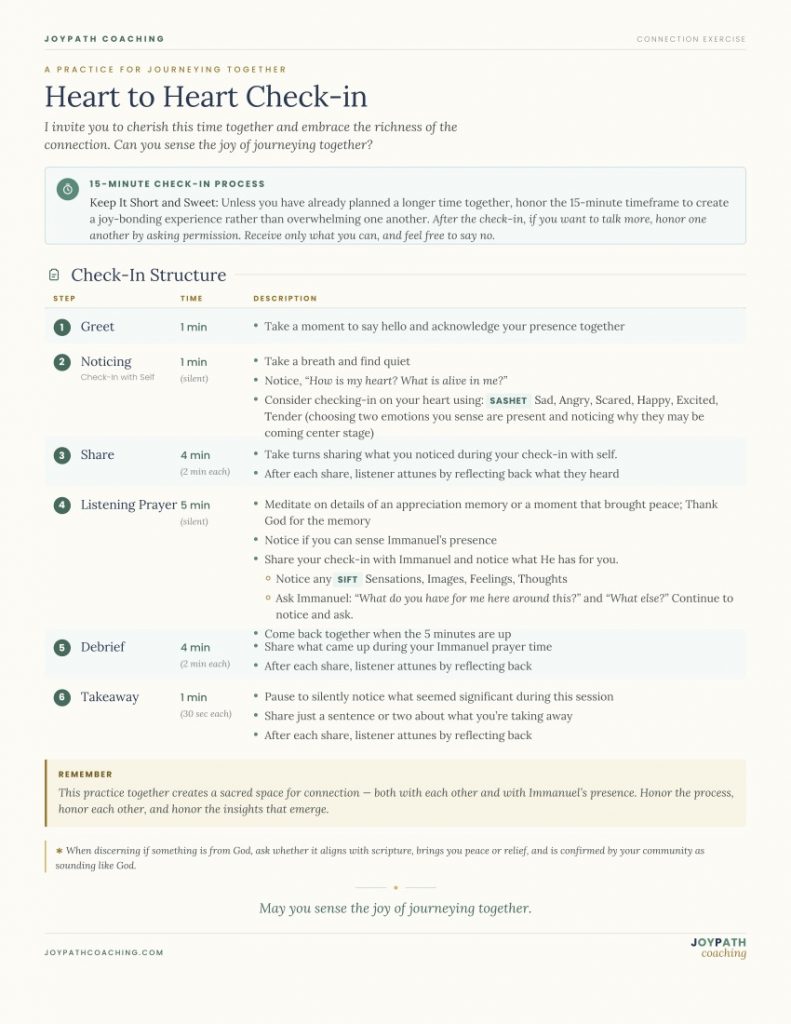
Step 1. Beginning With a Greeting
When we gather to practice this together, we begin simply, by greeting one another and taking a moment to acknowledge that we are here, present, in the same space. It asks very little of us, but it matters more than it seems. A warm hello, a look in the eye, a small word that says “I see you, and I am glad we are here.” This little act of welcome settles us, reminds us we are not alone, and gently opens the door to everything that follows.
Step 2. SASHET: A Simple Map for the Inward Turn
When we go looking inside, the words can feel elusive. SASHET gives us a place to begin: six families of feeling, Sad, Angry, Scared, Happy, Excited, Tender, enough language to find ourselves in almost any moment. Here is how the practice unfolds:
One. Notice what is here. Pause. Let the body speak. Is there tightness, heaviness, fluttering, warmth? What emotions might those sensations be pointing to? Emotions often arrive in the body before the mind finds the word. Receive the signal without rushing to explain it.
Two. Name it with SASHET. Reach for the word that fits, and remember that one word is often not enough. “Peaceful yet sad.” “Tender and a little scared.” The more precise the naming, the more honoring of what it is like to be you at the moment.
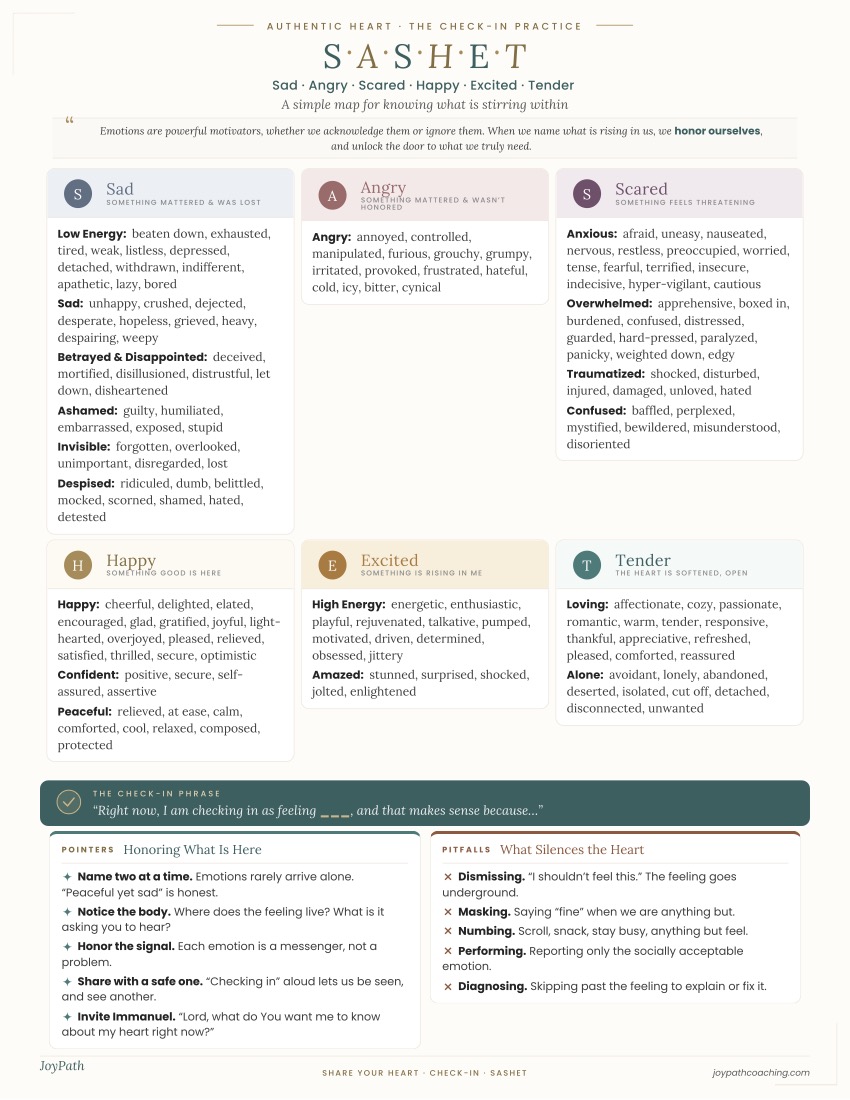
From this place of authenticiy you may honor what the emotion is saying. You may also curiously consider: What matters to me here? What do I need? Emotions are doorways. Emotions point us towards the the true desires we are longing for.
Step 3. What a Check-In Might Sound Like
“Right now, I am checking in as feeling peaceful yet sad. My dear friend, my source of joy, visited and has just returned home. I am experiencing a sense of loss, a gentle sadness, and also a peace that comes from knowing she is eager to return.“
Notice the shape of it. The feelings are named with care (peaceful yet sad), the cause is honored (a dear friend’s visit and departure). This is what it sounds like to share ones heart after they have noticed it. In a group, this is the moment when we take turns sharing what we noticed when we checked in on our heart, and the one listening simply reflects back what they heard. Each heart is attuned to and received.
Step 4. An Appreciation Memory Opens the Door
There is a tender bridge between noticing our hearts and noticing God, and it is one of the gentlest tools we know. Scripture has shown us the way in all along: “Enter into his gates with thanksgiving, and into his courts with praise: be thankful unto him, and bless his name” (Psalm 100:4, KJV). Thanksgiving is how we come into His presence. So before we ask Immanuel anything, we let ourselves return to an appreciation memory.
Call to mind a recent moment that brought a quiet smile. A cup of coffee in the morning light. A child’s laughter. An unexpected kindness. Let the memory open through your senses: what you saw, what you heard, the warmth or texture of it. Then notice what happens in your body as you linger there. Often the shoulders soften, the breath slows, and a small gladness rises.
This is not a detour from the practice. It is the doorway. When we study God or try to reach for Him with effort alone, we tend to stay in the analytical, problem-solving part of ourselves. But when we rest in genuine appreciation, a different and more relational part of us comes online, the part that knows how to feel connected and seen. From that quieted, grateful place, it becomes far easier to sense that we are not alone, that Immanuel has been here all along.
So the rhythm becomes: check in with your heart, settle into an appreciation memory, and from that place of peace, gently turn toward God.
Inviting Immanuel Into the Pause
Here is where checking in becomes more than self-awareness. It becomes a doorway to God’s presence. From that relational, appreciative place, we can turn and ask Immanuel (“God with Us”), “What do you have for me here around this?”
Then we simply notice how He answers. His response rarely comes as a booming voice. More often it arrives quietly, and the word SIFT helps us pay attention to the ways it can come: Sensations in the body, Images that rise in the mind’s eye, Feelings that shift, and Thoughts that gently surface. Receive whatever comes without straining to manufacture it. And when something does come, you can keep the conversation going with one tender question: “What else?” Continue to notice and ask, letting Him lead.
This is the heart of listening prayer, and the rhythm that shapes an Immanuel lifestyle. As you develop it, you’ll discover something beautiful: Immanuel is present and eager to meet you right where you are. Whether you’re feeling peaceful or overwhelmed, joyful or sad, pausing to listen creates space to sense God’s presence with you in every emotion. He is not distant or disapproving, but intimately present, wanting to connect with you in the midst of your real, daily experiences.
Step 5. Sharing What Surfaced
When we practice this together, we come back from the silence and share what came up in our time with Immanuel. This is the debrief, and its purpose is gentle but important: saying it aloud, and having it received, helps what we sensed settle and take root. We are not reaching for polished insights or tidy conclusions. We simply name what surfaced, a sensation, an image, a word, a quiet shift, or even the honest experience of stillness or difficulty.
Here the one listening has only one task, to attune. That means reflecting back what was heard without analyzing it, fixing it, or interpreting it for the other person. Something as simple as “I hear you experience______. I’m glad to be with you” lets a heart know it was heard. When an experience is witnessed this way, it integrates more deeply, and trust grows between us. And the range is always welcome: some sense a vivid encounter, others a quiet peace, others very little at all. All of it is welcome.
Step 6. Carrying It With Us
Finally, we pause to notice what seemed most significant about our time together, and each person shares just a sentence or two about what they are taking away. One small thing to carry into the week. Once more, the listener simply reflects it back.
This last step matters more than its brevity suggests. Naming what we are carrying, and speaking it aloud to someone who receives it, helps the experience take hold. The telling strengthens the very pathway we are trying to build, so that staying connected, to ourselves, to one another, and to God, becomes a little more our natural way in the days ahead.
Coming Home, Again and Again
As you make this rhythm your own, regularly pausing to ask “How is my heart? What is alive in me?” and then “Immanuel, what do you have for me here?”, you are building your capacity for joy, deepening your relational brain skills, and transforming the way you experience both human connection and divine presence.
Checking in is a small practice. But it is the sacred doorway through which we come home to ourselves, to one another, and to the God who is always, gently, with us.
If your heart is drawn to go deeper into listening prayer and learning to sense Immanuel’s presence with you, we warmly recommend the Life Model book Joyful Journey: Listening to Immanuel by E. James Wilder, Anna Kang, John Loppnow, and Sungshim Loppnow. It offers a gentle, practical guide to this very way of being with God, and it has been a treasured companion on the path so many of us are walking together.
With gratitude: the SASHET check-in tool is rooted in one developed by LK10, and we are thankful for the gift of it in our shared journey toward connection.